

White label lab testing lets your business sell blood tests under its own brand while a vendor handles the regulated parts. The customer buys from you, a licensed provider orders the test, the customer gives a sample at a lab or with a kit, a CLIA-certified lab runs it, and the result is delivered under your brand. On storefront models, you own the customer and set the price.
This guide walks through that flow step by step for gyms, coaches, med spas, creators and wellness brands. It covers who does what at each stage, where the money goes and how the four common models compare. If you’re deciding whether to start a lab business at all, begin with how to start a lab testing business.
What Happens From Purchase to Results?
Every white label lab order follows the same six steps, whichever vendor you use. What changes between vendors is who handles each step.
- Purchase. The customer picks a test or panel under your brand and pays.
- Intake. The customer answers a short patient intake so the ordering provider has what they need.
- Order. A licensed provider signs the lab order. Under CLIA, a lab must have a request “from an authorized person,” meaning someone “authorized under State law to order tests” (42 CFR 493.1241, 42 CFR 493.2).
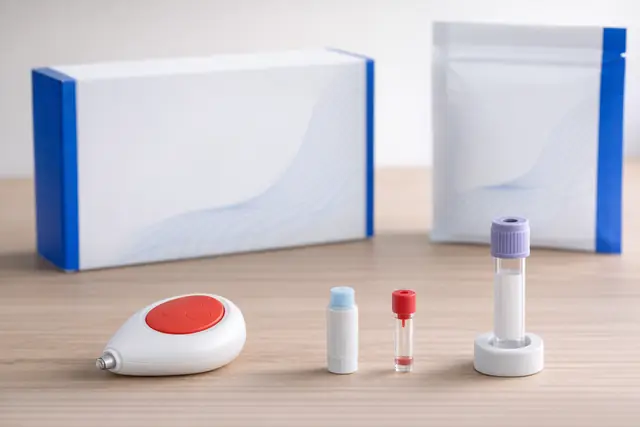
- Collection. The customer gives a sample at a lab patient service center, with a mobile phlebotomist or with an at-home kit.
- Testing. A CLIA-certified lab runs the test.
- Results. The report goes back to the customer, usually through a portal or app under your brand, and sometimes to a provider for review.
Here’s what that looks like on Karpa:
- Purchase: on Karpa’s ready-made white-label lab storefront, through a white-label checkout and patient portal on your own website, or in your own app through Karpa’s API.
- Order: a licensed provider in Karpa’s independent network orders every test. You need no medical license, and a labs-only brand needs no LegitScript certification.
- Collection: walk-in or booked draws at a Labcorp patient service center today. Branded at-home kits, including white-labeled Tasso devices above a minimum order quantity, launch December 1, 2026.
- Testing: Labcorp runs the tests.
- Results: the Labcorp report goes to the customer’s branded portal. Results are not reviewed by a provider by default; a provider reviews them only if the customer books a TRT or HRT consult.
Who Does What: The Brand vs. the Vendor
The brand sells and the vendor runs the regulated chain. A clear split looks like this:
| Job | Your brand | The vendor and its partners |
|---|---|---|
| Choosing which panels to sell | Yes | Supplies the test menu |
| Setting the retail price | Yes, on most storefront models | Sets your cost |
| Marketing and customer relationship | Yes | No |
| Storefront, checkout and portal | Your brand on it | Builds and hosts it, or supplies an API |
| Ordering each test | Never | A licensed provider in the vendor’s network, or your own clinicians on some models |
| Collecting the sample | No | Lab patient service centers, phlebotomists or kits |
| Performing the test | No | A CLIA-certified lab |
| Explaining what a result means | No, unless you’re licensed | A provider, if the model includes review |
The line that matters most is ordering and interpreting. A non-licensed business sells the test but doesn’t order it or tell a customer what a result means. Our guide on who can order lab tests explains why, profession by profession. The lab holds the CLIA certificate, so the brand doesn’t need one; see do you need a CLIA waiver to sell lab tests.
Who Holds the Money?
It depends on the model, and it’s the question to ask first. There are two basic patterns:
- The brand collects the payment. The customer pays your business, and the vendor bills you for its cost. You set the price and keep the margin. On Karpa, payments settle directly to your own Stripe account, and each lab order carries a $6 collection fee. Labs-only storefront pricing is shared on a call rather than published.
- The vendor collects the payment. The customer pays the vendor, and you earn through a fee or markup the vendor passes back. Fullscript, for example, says that by default “Fullscript bills your patient for testing,” and practitioners who want to earn on labs can add a custom service fee, on which Fullscript applies a 5% processing fee (Fullscript Support).
Some vendors don’t publish their payment terms at all, so ask before you sign. For setting prices once you know your cost, see how much to charge for lab tests.
What Are the Main White Label Lab Testing Models?
Four models cover most of the market. They differ on who orders, who builds the customer experience and who collects the money.
| Model | Who orders the test | How customers give samples | Who builds the customer experience | Best fit |
|---|---|---|---|---|
| Provider-ordered storefront | The vendor’s licensed provider network | Lab patient service centers, and kits on some platforms | The vendor, under your brand | Gyms, coaches, med spas and creators without clinicians or developers |
| White label at-home kit platform | Provider-of-record partners or the vendor’s physicians | At-home kits mailed back to a lab | The vendor’s portal, or your own app through an API | Health plans, digital health companies and brands built around at-home testing |
| Lab testing API | The vendor’s physician network or your own clinicians | Kits, mobile phlebotomy or lab walk-ins, depending on the vendor | You, in your own app | Digital health companies with an engineering team |
| Practitioner-ordering service | You, under your own license, or a signing-physician network | Lab draws and specialty kits | The vendor’s patient experience | Licensed practitioners ordering for their own patients |
A few published examples of each:
- Provider-ordered storefront. Karpa’s lab storefront, described above, where a licensed provider in Karpa’s independent network orders every test and the brand sets the price.
- White label at-home kit platform. Ash says it “offers a fully white-labeled experience” in which patients “interact solely with your brand,” that it partners with third-party provider-of-record services to order tests, and that kit and result distribution can run “via API or in our Client Portal.” Its FAQ doesn’t list pricing or minimums (Ash). See Karpa vs Ash Wellness.
- Lab testing API. Junction’s documentation describes three ordering flows: its own physician network orders and reviews results, the customer’s own physician handles both, or Junction orders while the customer’s physician reviews and follows up. Junction says its physician network “will always be notified” of critical results (Junction docs). See Karpa vs Junction and Karpa vs Health Gorilla.
- Practitioner-ordering service. On Fullscript, practitioners and staff place lab orders, and the patient pays Fullscript by default (Fullscript Support). See Karpa vs Rupa Health and Karpa vs Evexia.
For a side-by-side of more companies, matched to the need each one fits, see the best white label lab testing companies. It also covers when Karpa is not the right fit, such as when you need specialty kit tests from labs like DUTCH or Genova, which Karpa doesn’t offer.
How Do Customers Give Their Sample?
Customers give blood in one of three ways: a draw at a lab patient service center, a fingertip or upper-arm device at home, or a visit from a mobile phlebotomist. Each changes the experience you can promise.
- Lab draw. The widest test menu and a familiar process. The customer has to get to a location. On Karpa, this is a Labcorp patient service center, walk-in or booked, in 47 states plus Washington DC. Karpa doesn’t cover Hawaii, Maine or North Dakota, where Labcorp has no patient service center.
- At-home kit. Convenient and easy to sell on a schedule, such as a retest every quarter. Fewer tests are validated for small capillary samples. On Karpa, branded at-home kits launch December 1, 2026.
- Mobile phlebotomy. Offered by some vendors. It’s convenient for the customer and adds cost.
Our comparison of Tasso vs finger prick vs lab draw goes deeper on the trade-offs.
What Happens After Results Come Back?
Results go to the customer, and what happens next depends on whether the model includes provider review. Know the answer before you write your marketing.
On Karpa, results land in the customer’s branded portal and are not reviewed by a provider by default. If the customer books a TRT or HRT consult, a provider reviews them then. That matters for your copy: don’t promise a doctor will look at every result.
Results are also where a lab brand grows. A customer who checks testosterone, thyroid, A1c or lipids may want a retest or a treatment program. The same brand on Karpa can add TRT, HRT, GLP-1 weight loss and peptide programs, from $297 a month plus a one-time implementation fee. A gym-specific version of this path is in our guide to blood testing for gyms.
Questions to Ask Any White Label Lab Vendor
- Who orders each test, and are they licensed in my customer’s state?
- Which lab performs the tests, and does it hold the state permits needed for the states I sell in?
- How do customers give samples, and where?
- Who collects the customer’s payment, and when do I get paid?
- Who sets the retail price?
- Does a provider review results by default, and what happens with a critical value?
- What’s under my brand: the storefront, the portal, the emails, the kit?
- Which states are excluded, and why?
The Bottom Line
White label lab testing splits the work cleanly. Your brand sells, prices and keeps the customer. A licensed provider orders, a CLIA-certified lab performs the test, and the vendor’s software delivers the result under your name. The models differ on who orders, who builds the experience and who holds the money, so ask about those three before anything else.
To compare vendors, see the best white label lab testing companies. Or book a call to see the full flow on a Karpa lab storefront.