

You don’t have to open a lab to start a lab testing business. You can sell provider-ordered blood testing under your own brand, which is what white label lab testing means: a licensed provider orders each test, a CLIA-certified lab such as Labcorp runs it, and you own the brand, the price and the customer. You need no medical license, no lab director and no equipment. This guide covers how the model works, who legally orders the tests, how customers get tested, which panels sell, how to price them, what it costs and how to launch.
It is written for business owners: gym owners, personal trainers, health coaches, med spas, chiropractors, supplement brands, creators and telehealth brands that want to add lab testing to what they sell.
What Does a Lab Testing Business Look Like for a Non-Clinician?
For a non-clinician, a lab testing business is a branded storefront that sells blood tests run by an established lab. Your customer picks a panel on your site, completes a short intake form, pays you, gets their blood drawn, and receives the lab report in a portal with your brand on it.
Most guides on starting a lab testing business describe a different business: opening your own clinical laboratory with equipment, staff and a CLIA certificate. That is a real path, but it is a capital project for lab professionals. For a gym, coach or brand, the question is simpler: how do I sell testing to the customers I already have, under my own name? There are three ways to do it.
| Resell provider-ordered testing under your brand | Open your own CLIA lab | Affiliate link to a DTC lab | |
|---|---|---|---|
| Whose brand the customer sees | Yours | Yours | The lab’s |
| Who orders the test | A licensed provider | A licensed provider or, where state law allows, the customer | The DTC company’s providers |
| Who runs the test | Labcorp | You | The DTC company’s lab |
| Medical license needed | No | No, but a qualified lab director is required | No |
| CLIA certificate needed | No (the lab holds it) | Yes, plus inspections for moderate and high complexity testing | No |
| Who sets the price | You | You | The DTC company |
| Revenue per order | Your retail price minus testing cost | Your price minus your full lab costs | A commission, if the program pays one |
| Who owns the customer relationship | You | You | The DTC company |
| Path to TRT, HRT or GLP-1 programs | Same brand, add programs later | Separate build | None for you |
For most non-clinicians, reselling provider-ordered testing is the only path that keeps the brand and the customer without building a lab. The affiliate route is fast but leaves you with a commission and no customer list. We compare the affiliate and own-brand models in more depth in telehealth affiliate program vs. your own brand. To compare specific providers, see the best white label lab testing companies, which compares companies on who orders the test, how samples are collected and who sets the price.
Why Is Opening Your Own Lab So Much Heavier?
Opening your own lab means becoming a regulated clinical laboratory. CMS, which runs the CLIA program, says that if a facility “performs even one test on human samples to assess health or to diagnose, prevent, or treat any disease,” it is a laboratory under CLIA and must get a CLIA certificate (CMS).
The standard wellness panels people want, such as hormones and lipids run on a lab analyzer, are generally nonwaived tests. CMS says labs performing nonwaived (moderate or high complexity) tests must have a CLIA certificate, be surveyed (inspected) and meet the CLIA quality standards. Certificates last two years and the fees recur every two years. Each lab also needs a director who meets federal education, experience and training requirements for the complexity of testing and who is responsible for the lab’s overall operation (CMS).
Add equipment, licensed staff, specimen handling, quality control and state rules on top, and a lab becomes its own company. If what you want is to sell testing to your audience, you can skip all of it by selling testing that an existing CLIA-certified lab already performs.
Who Legally Orders the Tests?
A licensed provider orders the tests. Under federal CLIA rules, a lab must have “a written or electronic request for patient testing from an authorized person” (42 CFR 493.1241), and an authorized person is someone “authorized under State law to order tests or receive test results, or both” (42 CFR 493.2).
State law decides who that is. In most states it is a licensed clinician such as a physician, nurse practitioner or physician assistant. Some states also let consumers order some tests directly: a 2015 ADLM position statement counted 37 states plus Washington DC that permit consumers to order some or all of their tests without a physician (ADLM). That patchwork changes and varies by test, which is why national consumer services route orders through providers. Labcorp’s own consumer service, Labcorp OnDemand, says all of its testing “requires an order from an authorized healthcare professional” (Labcorp OnDemand).
A business owner who is not a clinician should not be the one ordering. On Karpa, a licensed provider in Karpa’s independent network orders every test. You never order, interpret or diagnose. For the state-by-state detail, see who can order lab tests.
How Do Customers Get Tested?
Customers get tested in one of two ways: at a Labcorp patient service center or with an at-home collection kit.
Labcorp patient service center. The customer walks in or books a time at one of Labcorp’s nearly 2,200 patient service centers (Labcorp). Labcorp says walk-ins are welcome but appointments are recommended, and appointments can be booked up to 90 days ahead (Labcorp). A standard venous draw supports the widest test menu.
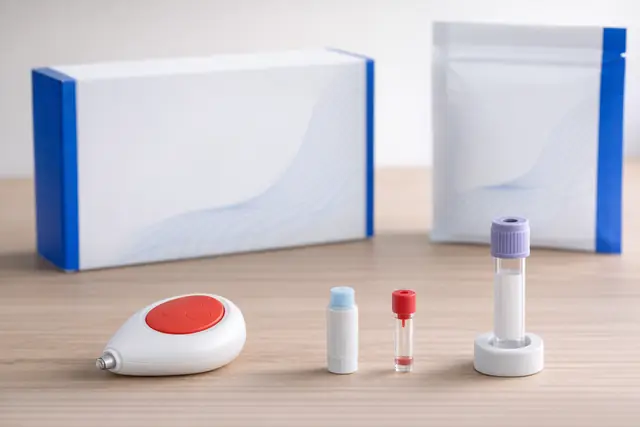
At-home collection kit. The customer collects a sample at home with a branded kit and mails it to the lab. This suits customers who live far from a patient service center or who will retest on a schedule. On Karpa, branded at-home kits launch December 1, 2026.
White-label Tasso subscriptions. Tasso makes an at-home blood collection device. The Tasso+ received FDA 510(k) clearance in 2022 (FDA). Starting December 1, 2026, above a minimum order quantity, Tasso devices can be white-labeled under your brand and sold as a subscription, for example a retest every quarter. That turns a one-off sale into recurring revenue.
Many brands offer both: the patient service center for the first full panel and at-home kits for follow-up testing. We compare the collection methods in Tasso vs. finger prick vs. lab draw.
Where Do Customers Buy the Tests?
On Karpa, customers can buy from you in three ways, and you can use more than one:
- Karpa’s white-label lab storefront. A storefront under your brand and domain, with checkout and patient intake built in. It suits a business without a website, or one that wants labs live fast.
- Your own website. Add Karpa’s lab ordering checkout and patient portal to the site you already have, so customers never leave your brand.
- Your own app or platform, through Karpa’s API. Build lab ordering into your product and receive each step back through a webhook.
Whichever you choose, a licensed provider in Karpa’s network orders every test, Labcorp runs it, and payments settle to your own Stripe account.
Which Lab Panels Sell?
The panels that sell are the ones tied to a goal your customers already care about.
| Panel | Typical buyer | Why it sells |
|---|---|---|
| Male hormones (testosterone and related markers) | Gym members, men’s health audiences, TRT-curious men | Low energy, slow recovery and libido questions |
| Female hormones | Women in perimenopause or menopause | Symptoms they want to understand |
| Thyroid | Women’s health and weight loss audiences | Fatigue and weight questions |
| Metabolic and A1c | Weight loss and longevity audiences | Blood sugar is the number they watch |
| Lipids | Fitness, longevity and heart health audiences | A baseline before and after a training or diet change |
| General wellness | Any audience | An easy first purchase that covers the basics |
Start with two or three panels, not a full menu. A gym might lead with a male hormone panel and a general wellness panel. A weight loss coach might lead with A1c, lipids and thyroid. On Karpa you can also build custom panels and create discount codes from the partner portal. For gyms specifically, see blood testing for gyms.
How Much Should You Charge, and What Is the Margin?
You set the retail price. Partners on Karpa typically charge $50 to $200 or more per order and aim for around a 50% margin per order, and payments settle to your own Stripe account.
For a benchmark, Labcorp OnDemand lists a total testosterone test at $69 as of November 2026 (Labcorp OnDemand). Your customers can find prices like that, so price a single marker close to the market and earn more on multi-marker panels, at-home kits and subscriptions, where convenience and your brand matter more than the sticker price.
Three pricing habits help:
- Bundle. A panel that answers one clear question (“is my testosterone low?”) sells better than a list of individual markers.
- Offer a retest. Quarterly retesting with an at-home kit gives you recurring revenue and gives the customer a reason to stay.
- Use discount codes for launches. A members-only code for the first month gets your existing audience to try it.
For a full breakdown of costs, markups and competitor prices, see how much to charge for lab tests.
Which States Can You Sell In?
On Karpa, a lab testing brand can sell in 47 states plus Washington DC. Hawaii, Maine and North Dakota are not available, because Labcorp has no patient service center there. If a meaningful share of your audience lives in those three states, factor that into your launch plan.
What Does It Cost to Start a Lab Testing Business?
The cost depends on which pieces you build yourself. If you build the business on your own, you need to put together:
- A provider network licensed in every state you sell in, to order the tests
- A lab account with an established lab and an ordering connection to it
- A storefront with a patient intake form and checkout
- A results portal that delivers the lab report to the customer
- Payments, refunds and order tracking
- At-home kit sourcing and fulfillment, if you offer kits
Each of those is a separate contract or build, and the provider network alone is a project for most non-clinicians.
On Karpa, those pieces come as one automated lab storefront under your brand:
- No website build needed. The storefront runs under your brand.
- No medical license needed. A licensed provider in Karpa’s independent network orders every test.
- No LegitScript certification needed for a labs-only brand.
- Patient intake form built into the storefront.
- Partner portal showing revenue, orders, lab results, custom panels and discount codes.
- Your own Stripe account receives the payments, at the prices you set.
When a customer’s results come back, the Labcorp report lands in their branded portal. Results are not reviewed by a provider by default. A provider looks at them only if the patient books a TRT or HRT consult. Book a call for current lab pricing on our diagnostic labs page.
For the cost of a full prescription telehealth launch, see telehealth clinic startup costs.
How to Start a Lab Testing Business, Step by Step
- Pick your audience and your first panels. Start with the two or three panels your customers already ask about, using the table above.
- Choose how you will deliver the testing. For most non-clinicians, reselling provider-ordered testing under your brand beats opening a lab or sending customers to someone else’s brand.
- Set your prices. Aim for around a 50% margin per order and check your prices against consumer lab sites.
- Connect payments. Connect your own Stripe account so each order settles to your business.
- Choose your collection options. Offer Labcorp walk-in or booked appointments, branded at-home kits (launching December 1, 2026), or both. Consider a white-label Tasso subscription for quarterly retests once kits launch.
- Launch to the customers you already have. Announce it to your members, clients, email list or followers, and put the link wherever they already find you, such as your booking page, your app or your link in bio.
- Add prescription programs when demand shows up. See the next section.
How Do Lab Tests Lead Into TRT, HRT and GLP-1 Programs?
Lab testing is the natural first step toward prescription programs. A customer who checks their testosterone, thyroid, A1c or lipids often wants to do something about the number next, and the next step is a provider consult for TRT, HRT or GLP-1 weight loss.
On Karpa, the same brand can add prescription telehealth programs (TRT, HRT, GLP-1 weight loss, peptides and others) when you are ready. Those programs start at $297 a month plus a one-time implementation fee, and LegitScript certification through Karpa costs $3,000. Karpa powers more than 50 telehealth brands, and the partner owns the brand and the customer relationship in each one.
The sequence that works:
- Hormone panel, then TRT or HRT. A man with low testosterone or a woman in perimenopause can book a consult with a licensed provider under your brand. See the TRT brand guide and how to launch an HRT telehealth brand.
- A1c and lipids, then GLP-1 weight loss. A customer watching their metabolic numbers is a likely weight loss patient.
- Retest subscriptions, then ongoing care. Quarterly at-home testing keeps the customer engaged with your brand between purchases.
Starting with labs lets you learn what your audience buys before you commit to a prescription program. For the general model, see how to launch a telehealth clinic without a medical license.
The Bottom Line
A lab testing business for a non-clinician is a branded storefront for testing that a licensed provider orders and an established lab runs. You skip the CLIA certificate, the lab director and the equipment, and you keep the brand, the price and the customer. Start with two or three panels your audience already wants, price for around a 50% margin, offer Labcorp locations now and at-home kits from December 1, 2026, and add TRT, HRT or GLP-1 programs when your customers ask for the next step. See how the storefront works on our diagnostic labs page, or book a call.