

How much to charge for lab tests comes down to your cost and your margin. Start from your total cost per order, apply a margin target (at 50%, you charge twice your cost), then check the result against what consumer labs charge for the same markers. As of November 2026, Labcorp OnDemand, Quest and Walk-In Lab list a CMP at $30 to $49, a CBC at $27 to $29 and a broad wellness panel at $189 to $399.
This guide is for gyms, trainers, coaches, med spas, chiropractors, supplement brands and creators who want to sell lab testing under their own name. It covers current retail benchmarks, how to set your price, the margin math with your own cost, recurring revenue from retests, and the mistakes that eat profit. If you haven’t set up the business yet, start with our guide on how to start a lab testing business.
What Do Direct-to-Consumer Labs Charge for Blood Tests?
As of November 2026, the major consumer sellers list single tests at $27 to $99 and broad panels at $189 to $399. You aren’t competing to be the cheapest lab, but these are the prices your clients can find in one search, so they work as the ceiling for single tests and the reference point for panels.
We checked list prices on Labcorp OnDemand, Quest (questhealth.com) and Walk-In Lab on November 8 and 9, 2026, using each Labcorp OnDemand test’s own product page. Promo-code prices are left out, since they change week to week. A dash means we couldn’t find a standalone version of that test in the seller’s public catalog.
| Test or panel | Labcorp OnDemand | Quest | Walk-In Lab |
|---|---|---|---|
| CMP (comprehensive metabolic panel) | $49 | $49 | $30 |
| CBC (complete blood count) | $29 | $29 | $27 |
| Lipid (cholesterol) panel | $59 | $59 | $33 |
| Hemoglobin A1c | $39 | $39 | $35 |
| TSH | $49 | $49 | $35 |
| Thyroid panel | $89 (Standard Thyroid Test) | $149 (Comprehensive Thyroid Test Panel) | $50 (Thyroid #1 Baseline) |
| Total testosterone | $69 | $69 | $59 |
| Total + free testosterone | $159 (Comprehensive Testosterone, free calculated) | $152 (Men’s Hormone Panel, Basic) | $99 |
| Estradiol | $79 | – | $49 |
| PSA | $69 | $69 | $49 |
| Vitamin D | $99 | $75 | $59 |
| Ferritin | $59 | $59 (Iron, TIBC & Ferritin Panel) | $29 |
| Vitamin B12 | $49 | $82 (Vitamin B12 & Folate) | $35 |
| hs-CRP | $69 | – | $45 |
| Magnesium | $39 | – | – |
| Men’s health panel | $219 (Men’s Health Test) | $220 (Men’s Hormone Panel, Expanded) | $295 (Health Check Panel, Men) |
| Broad wellness panel | $189 (Comprehensive Health Test) | $399 (Elite Health Profile, 85+ markers) | $195 (Wellness #2 + A1c) |
A few notes on reading the table:
- Fees on top. Quest adds a physician service fee starting at $6, and Walk-In Lab adds a $6 per-order physician fee. Labcorp OnDemand’s Comprehensive Health Test page lists no separate fee.
- Sales are common. Quest showed its Men’s Hormone Panel, Basic at $121.60 against a $152 list price, its Expanded panel at $176 against $220 and its thyroid panel at $119.20 against $149. Walk-In Lab ran 15% codes on many tests.
- Free testosterone is measured differently. Labcorp OnDemand’s Comprehensive Testosterone Test measures total testosterone, SHBG and albumin and reports a calculated free testosterone; its FAQ says it does not measure free testosterone directly. Walk-In Lab’s $99 test measures free testosterone directly, and Quest’s Basic panel reports free, bioavailable and total testosterone with SHBG and albumin.
- How the consumer route works. On Labcorp OnDemand, the consumer buys online, a provider reviews and approves the test request, and the sample is collected at a Labcorp location.
- Panels differ. A “thyroid panel” or “wellness panel” means something different at each seller. Labcorp OnDemand’s $189 Comprehensive Health Test covers CMP, CBC with differential, lipids, A1c and urinalysis. Labcorp OnDemand’s $219 Men’s Health Test adds total testosterone to that set. Compare panels by the markers inside them.
Two takeaways for your pricing. Single tests from the cheapest seller are hard to beat on price, and the gap between single-test prices and panel prices is where a branded lab business makes its money.
How Should You Set Your Lab Test Prices?
Set your price from your cost and target margin first, then check it against the benchmarks and adjust for how your brand is positioned. Your customers are buying from you because they trust you and the test fits a goal they already have, so you don’t need to be the cheapest. You do need a price that makes sense next to what they could find on their own.
Position against the benchmark
Decide where you want to sit relative to the table above:
- At or near retail. Price close to Labcorp OnDemand and Quest list prices. This works for gyms and coaches selling to existing members, who value convenience and your recommendation more than a $10 saving.
- Premium. Price above retail when the panel is built for a specific goal and comes with your program around it, such as a training block, a weight loss plan or a quarterly check-in with you. Your customer pays for the whole package.
- Entry offer. Price a starter panel close to cost to bring in new customers, then earn margin on the retest subscription and on later programs.
Bundle single tests into panels
Panels are the strongest pricing lever you have. A customer asking “why am I tired?” doesn’t want to pick between a CBC, a TSH and a vitamin D test. They want one order that covers the question.
Build three to five panels around goals your audience already talks about:
| Panel idea | Markers that might go in it | Who buys it |
|---|---|---|
| Baseline / annual check | CMP, CBC, lipid panel, A1c | Any member or client, once a year |
| Men’s performance | Total + free testosterone, SHBG, estradiol, CBC, lipids | Lifting gyms, men’s coaches |
| Energy and fatigue | CBC, TSH, vitamin D, ferritin, A1c | Coaches, med spas, wellness creators |
| Women’s hormone | Estradiol, FSH, LH, TSH, testosterone | Women’s fitness and wellness brands |
| Metabolic / weight loss | A1c, fasting glucose, insulin, lipid panel, CMP | Weight loss coaches, med spas |
A goal-based panel is also harder to price-compare marker by marker, which protects your margin. On Karpa, you build custom panels in the partner portal and set the retail price of each one.
Offer a membership or subscription retest
A retest gives the customer a reason to buy again and gives you a number to track. Quarterly works for goals that change, such as training, weight loss or hormone levels. Annual works for a baseline check. Price the subscription slightly below the one-off price per test so the customer has a reason to commit. There’s more on this below.
Use discount codes on purpose
Discount codes are useful for launches, challenges, affiliates and members. They come straight out of your margin, so set them before you need them:
- Give members a fixed code that you have already priced in.
- Run time-limited codes for a launch or a challenge, then turn them off.
- Give each affiliate or partner their own code so you can see who drives orders.
On Karpa, discount codes are managed in the partner portal next to your orders and revenue.
What Is the Profit Margin on Lab Testing?
There is no published industry margin for branded lab storefronts, so pick a target. About 50% per order is a sensible starting point. At a 50% margin, your retail price is your cost multiplied by two, and half of every sale is gross profit before card fees and marketing.
Your cost depends on the panel and your setup, so the examples below use made-up costs. Plug in your own.
A worked example
These numbers are illustrations only. They are not Karpa’s costs or any lab’s wholesale prices.
| Example | Your cost (example) | Price at 50% margin | Gross margin per order | Card fee (2.9% + 30¢) | Margin after card fee |
|---|---|---|---|---|---|
| Single test | $25 | $50 | $25 | $1.75 | $23.25 |
| Baseline panel | $60 | $120 | $60 | $3.78 | $56.22 |
| Hormone panel | $100 | $200 | $100 | $6.10 | $93.90 |
The formula is simple: price = your cost ÷ (1 − target margin). On Karpa, include the $6 collection fee in your cost. At a 50% target, that is cost ÷ 0.5. At a 40% target, a $60 panel sells for $100.
Card processing comes out of every sale. Stripe’s standard rate for US cards is 2.9% plus 30 cents per successful transaction, according to Stripe’s pricing page. On Karpa, payments settle to your own Stripe account, so you see those fees directly.
What discounts do to the math
Say your cost is $60 and you sell a panel at $120. A 20% discount code drops the price to $96. Your margin falls from $60 to $36, which is 37.5% of the discounted price. Run that same code on a single test with a $25 cost and a $50 price, and you keep $15 instead of $25.
That is why discounts belong on panels and subscriptions, where the dollar margin can absorb them, and rarely on single tests.
Why single tests make poor products
A $50 single test at a 50% margin earns you $25 before card fees, the same effort to sell as a $120 panel that earns $60. Customers who only want one cheap test can also find it for $27 to $35 at Walk-In Lab. Sell single tests as add-ons to a panel, and sell panels as the main product.
How Do Lab Retests Create Recurring Revenue?
A retest sold on a schedule turns one lab sale into several a year. A customer who checks a marker once and then changes something, such as their training, diet or weight, usually wants to see whether it moved.
Here is an illustration with example numbers, not a forecast:
- 100 customers on a quarterly retest subscription
- $40 gross margin per retest (from an example $80 price and $40 cost)
- 4 retests a year each
That is $16,000 a year in gross margin from 100 customers, or about $14,950 after Stripe’s standard card fee, before marketing. Your retention, prices and costs will differ, so use your own.
White-label Tasso subscriptions
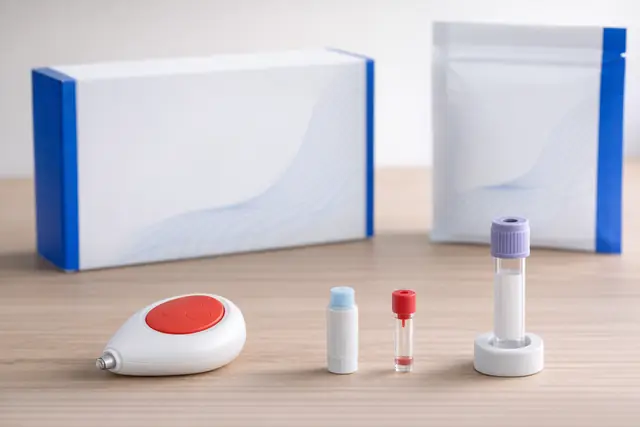
At-home collection makes a subscription easier to keep, because the customer doesn’t have to go anywhere. On Karpa, starting December 1, 2026 and above a minimum order quantity, Tasso at-home collection devices can be white-labeled under your brand and sold as a subscription, for example a retest every quarter. The kit shows up with your name on it, and the customer collects the sample at home.
For a comparison of Tasso devices, finger-prick kits and lab visits, including which tests each can handle, see our guide to at-home blood collection: Tasso vs finger prick vs lab.
Labs as an entry point to programs
The same customer who checks testosterone, thyroid, A1c or lipids is often the next TRT, HRT or GLP-1 weight loss patient. On Karpa, you can add prescription telehealth programs under the same brand later, from $297 a month plus a one-time implementation fee, with LegitScript certification at $3,000 through Karpa. A lab panel priced near cost can still pay off if it leads to a monthly program. See how to launch an HRT telehealth brand or the TRT brand guide for that path.
What Is Included in the Price the Patient Sees?
On Karpa, the retail price you set covers the licensed provider’s order and the results in the patient’s portal, and each order also carries a $6 collection fee. Count that fee in your cost when you set prices, and make sure the customer sees the full amount before checkout. Here is what happens after a customer pays:
- Intake. The customer fills in a short patient intake form under your brand: on Karpa’s white-label storefront, on your own website through Karpa’s checkout, or in your app through the API.
- Provider order. A licensed provider in Karpa’s independent network orders the test. You never order, interpret or diagnose. Our guide on who can order lab tests explains why that matters.
- Collection. The customer walks in or books a time at a Labcorp patient service center (Labcorp runs 2,200+ locations), or, from December 1, 2026, uses a branded at-home collection kit.
- Results. The Labcorp report lands in the customer’s branded portal.
Be clear in your copy about what the price doesn’t include. Results are not reviewed by a provider by default. A provider looks at them only if the patient books a TRT or HRT consult. Some consumer sellers include a provider conversation in their price, so if you sell at a premium, your value needs to come from the panel design, the convenience, the retest schedule and the program around it.
The service runs in 47 states plus Washington DC. It isn’t available in Hawaii, Maine or North Dakota, where Labcorp has no patient service center. More on the full setup on our diagnostic labs page.
What Are the Most Common Lab Pricing Mistakes?
The most common mistake is pricing single tests to compete with the cheapest online lab, which leaves almost no margin and no reason to buy from you. Others to avoid:
- Pricing without knowing your cost. Get your per-panel cost before you set a single price, then work forward from your margin target.
- Forgetting card fees and discounts. 2.9% plus 30 cents is small on a $200 panel and noticeable on a $40 test. Price discounts in before you launch them.
- Too many products. Fifty single tests confuse customers. Three to five goal-based panels are easier to sell and easier to explain.
- Copying a competitor’s panel name without its contents. “Wellness panel” means something different at every seller. Price by markers, and list them on your product page.
- Hiding the full price. If a customer reaches checkout and finds an extra fee, they leave. Show one price that covers the order.
- No retest offer. A one-time sale leaves the easiest revenue on the table. Offer the retest at checkout or when results land.
- Promising what the test doesn’t include. Don’t suggest a provider will review results or follow up unless the customer books a consult that includes it. Keep claims about what a test shows to what the test measures.
- Never revisiting prices. Consumer lab prices and sales change. Recheck the benchmarks every few months, as we did for this guide in November 2026.
How to Set Your First Lab Prices
- List the three to five panels your audience wants. Start from the goals your clients already bring you.
- Get your cost for each panel. Your platform or lab partner should give you a per-panel cost before you set any price.
- Apply your margin target. Divide cost by 0.5 for a 50% margin, then subtract card fees to see your real number.
- Check the benchmarks. Compare each panel to the closest Labcorp OnDemand, Quest and Walk-In Lab option by markers.
- Pick a retest schedule and price. Quarterly for goals that change, annual for a baseline.
- Set your discount codes. Decide member, launch and affiliate codes before launch, with the margin they leave.
The Bottom Line
Price lab tests from your total cost per order, start with a margin target of about 50%, and check your panels against what Labcorp OnDemand, Quest and Walk-In Lab charge. Sell goal-based panels instead of single tests, add a quarterly retest subscription, and keep discount codes for panels where the margin can absorb them. To see your costs and build your first panels, read the main lab testing business guide, look at how diagnostic labs work on Karpa, or book a call.